The deep water test and the three pools
Each of Wedgewood's three pools has a job, and the deep water test decides which ones a child under 12 can use.
October 27, 2026 · 4 min read
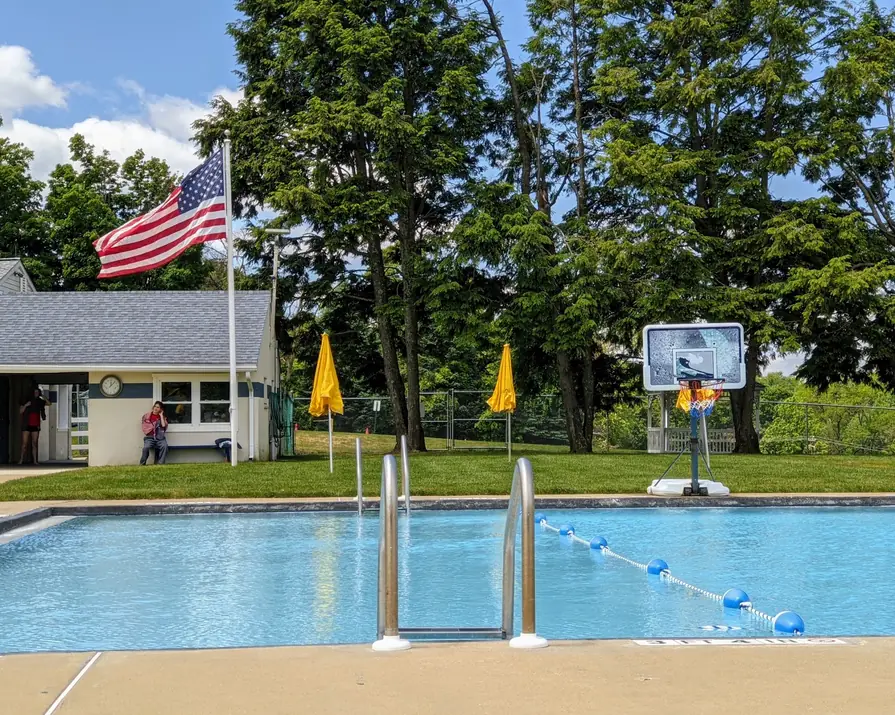
If you have young swimmers, the first thing to learn about Wedgewood Swim Club is that the three pools aren't interchangeable. Each has a job, and the deep water test is what decides which ones your child can use on their own. A few minutes with the rules now makes the whole summer easier.
Three pools, three jobs
The main pool is the original pool at the club, dating to 1958. It's L-shaped, 75 by 36 feet, with a 30 by 25 foot diving area, and it runs from 3 to 10 feet deep. That's where the diving board and the water slide live.
The lower pool, also called the lap pool, is the newest. It's a standard 25 meter pool with six lanes, 4 to 5 feet deep, and the swim team practices there. It's only for people who have passed the deep water test. The baby pool is 38 by 30 feet and between 9 inches and 1 foot 8 inches deep. It sits right beside the pavilion and picnic area, so a parent in the shade can see it. Four to five feet sounds shallow until you picture a seven-year-old standing in it, which is exactly why the lower pool has a gate of its own: the test.
What the deep water test is
Under the club's safety policy, children under 12 aren't permitted alone in water over their heads until they've passed a deep water test given by the pool manager or a lifeguard. Tests are available on request and scheduled around availability, so ask early rather than on the hottest Saturday of July. The club's swim lessons page calls the same milestone the Green Tag Test, the one that lets a swimmer use all areas of the pools.
The club doesn't publish the details of the test on its policy pages, so ask the pool manager or a lifeguard what to expect. In general, tests like this check that a child can enter deep water, stay afloat without panic, move in a controlled way and reach the wall without help.
Getting ready for it
Most children who struggle with a deep water test struggle with calm, not strength. Practice that builds calm is more useful than racing laps. These are good things to work on at the shallow end or in the lower pool with an adult nearby:
- Floating on the back and the front until it's relaxed, not rigid.
- Treading water for a minute or more with a steady kick and sculling hands.
- Swimming a distance without standing up, even if the stroke is not pretty.
- Rolling from back to front and back again, then finding the wall.
- Putting the face in the water and breathing out slowly.
Members who want help can use the swim lessons the swim team offers when instructors are available. Lessons are members only, run through the full-time hours from mid-June, and are taught by coaching staff, lifeguards and high-school-aged team members with instruction experience. Small groups of two to four swimmers can be arranged for siblings or friends. The interest form doesn't guarantee a spot, and noon to 2 p.m. is usually when instructors are most available. Tim Horan directs the program.
The baby pool is for building confidence
The baby pool is meant for pre-swimming children up to age 6, and a parent or adult should be with any child in it. The club also asks parents to remind older, swimming-age children that it's a safe space for building water confidence, and lifeguards may ask a child who isn't using it appropriately to move on. Children who aren't toilet trained should wear a swim diaper.
Supervision of toddlers works best at arm's reach. Shallow water can still be dangerous for a very small child, and the quiet kind of trouble makes little noise. Put the phone down when you're the adult in the baby pool.
Flotation devices are not a lifeguard
Any child wearing water wings, a tube, a life jacket or another flotation device must have an adult with them, either in the water or along the deck near the child. That rule matches good practice. Inflatable armbands and tubes can slip, deflate or tip a child face-down, and they teach a vertical posture that isn't how people actually swim. A life jacket made for the purpose and fitted properly is the better choice for a child who isn't yet a swimmer, and it still doesn't replace someone watching.
The slide, the diving well and everyone's manners
Anyone using the slide goes feet first and sitting. There's no diving in the upper pool, the main pool, except in the diving well by the board, and in the lower pool you follow the posted signs. The pool rules also rule out running, sliding, dunking, pushing and rough housing, and ask everyone to listen to the lifeguards.
Lifeguards, and your part in it
All three pools are staffed with trained lifeguards during all hours of operation. That's a real layer of protection, and it's one of several. Children under 12 come with a member over 16 or a registered nanny or babysitter, and that adult is part of the safety plan, too. Learn where the guards sit, point them out to your kids, and teach children to ask a guard when they're unsure about a rule.
Hours run from Memorial Day to Labor Day, from noon into the evening, with daily hours on the club calendar.
Wedgewood Swim Club, (610) 696-4390
Call (610) 696-4390More articles
How joining Wedgewood works
Wedgewood is member-owned and popular, so it helps to know how the wait list works and what a first summer asks of a new family.
Joining the Wedgewood Whales
About 200 swimmers ages 5 to 18 swim for the Whales each summer. Here's how a season fits together for a new family.